Showing posts with label rejection. Show all posts

Friday, January 04, 2013

The Worst That Could Happen

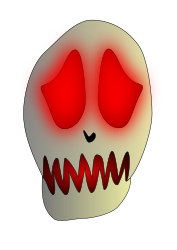
Sad Skull by mairor - I did this on a challenge, I didn't mean it to be sad, but I liked it and kept it that way."What's the worst that could happen?"  That's the question I ask myself when that icy cold, gut churning fear grips me just before I send off a submission of my writing. "That's easy," you say.  "The worst that could happen is a rejection.  They say 'no.'"  Ha!  Shows how little you know of the dark and fearful recesses of the writer's soul.  What's the worst that could happen?  They could say "no" and ...

They could laugh at me behind my back AND

They could pass my story around their office from one editor to another, laughing more hysterically with each moment AND

They could send me a scathing letter demanding to know how I could possibly ever have deluded myself into thinking that I could write or might be worthy of publication AND

They could post my story and query on their blogs as an example of what not to do, accompanied by their brutal point by point decimation of my work, AND

They could tweet throughout the twitterverse about my appallingly embarrassing lack of talent AND

They could read excerpts of my work at conferences to demonstrate the level of depraved crap that gets submitted to them on a daily basis AND

They could publish my name and contact information online as a warning to fellow members of the publishing industry that the mere possibility of contact with my writing might taint them and all connected with them as horrifically bad writers AND

They might launch a global campaign to have my name blacklisted from publication for all time AND

They  might issue a ban on my work throughout the publishing industry as punishment for the effrontery of my presumption that my work deserved consideration.

In my dangerously creative brain, that is, in fact, the worst that could happen.  Welcome to the curse of imagination.  Thankfully, some sane part of my brain says, "Yes.  That's the worst that could happen.  And it probably won't.  They'll probably just say 'no.'"  And so I take a deep breath and I put that envelope in the mail or click "submit" or "send" on the computer screen.  Because, hey, what's the worst that could happen?  They might say "yes."

Saturday, October 20, 2012

Yes, and ...

In improvisational comedy, and also in good brainstorming, there's a rule that you don't say "no" to any idea.  You say "Yes, and ..."  It's a hard rule to follow.

Last weekend I thought about this rule as I was slogging through one of my bouts with my friend the Big D (Depression).  The Big D doesn't like to say "yes" to anything or anyone unless it's something that keeps me at home.  For example, both members of my writing group had to cancel.  One asked if it was ok.  The Big D said "sure."  The rest of me desperately needed the connection, but felt incapable of asking for it thanks to Big D's super powers of sluggishness.  Then, another writer friend, one I've never hung out with one-on-one before, asked if I wanted to go to a Wordstock event.  "No!" insisted the Big D.  But the rest of me stopped and thought, "This is an answer to my sadness over canceling writing group this week."  I said "Yes" and was glad I did.

This got me thinking about the application of "Yes, and ..." to life, and also to writing.  When you're writing a first draft in particular, or are stuck on a piece, applying the rule of "Yes, and ..." can help break through.  The editor brain often wants to say "No."  Agents and publishers are looking for reasons to say "No," not because they hate you but simply because they can't publish or represent everything.  But your creative brain, the one that writes the damn stuff in the first place, needs to be trained to say "Yes, and ..."  "What if my protagonist jumps out the window here?"  "Yes, and then discovers she can fly."  "Yes, and then crashes into a building."

In my other writing group, someone mentioned the plot strategy of "Therefore" and "But then."  I'm tempted to sit down and rewrite my whole synopsis using only these 3 transitional phrases after the first sentence:  "Yes, and-"  "Therefore"  "But then."  It's bound to make the plot go SOMEWHERE.

Popular Posts

Contributors